Category Archives: Art Deco

“A rose by any other name . . .”

Entrance to the Rose Iron Works exhibit at the Cleveland Museum of Art.

Rose Iron Works and Art Deco at the Cleveland Museum of Art – July 6 – October 19, 2025.

A rose by any other name would still be Art Deco, well at least in this case. Chris and I took a whirlwind drive from Rochester and back in one day to catch this wonderful exhibit before it closed. The Rose Iron Works of Cleveland, Ohio created some very iconic Art Deco pieces. Our first encounter with their work was back in 2017 at the Cleveland Museum of Art / Cooper Hewitt’s joint exhibit The Jazz Age. On display were three pieces, a mirror and console table and the Muse with Violin screen.

The Jazz Age – American Style in the 1920s

Cooper Hewitt, 2017

We had originally planned to see the exhibit at the very end of August, but a sciatic nerve issue prevented any travel at that time. So this was our last chance to catch the exhibit. Since Cleveland is less than four hours from Rochester it was a doable day trip.

Chris is ready to see the Art Deco treasures.

Chris is ready to enjoy the exhibit.

This was an intimate exhibit rather than comprehensive. But what was there was choice. Tracing the work of Martin Rose from his European origins through his to his iconic Art Deco pieces made in collaboration with Paul Fehér at his Cleveland iron works.


Rose Iron Works Art Nouveau Plant Stand

Art Nouveau copper and bronze plant stand designed in 1907 by Martin Rose for the Rose Iron Works.

Circa 1907, copper and bronze plant stand designed by Martin Rose for the Rose Iron Works.

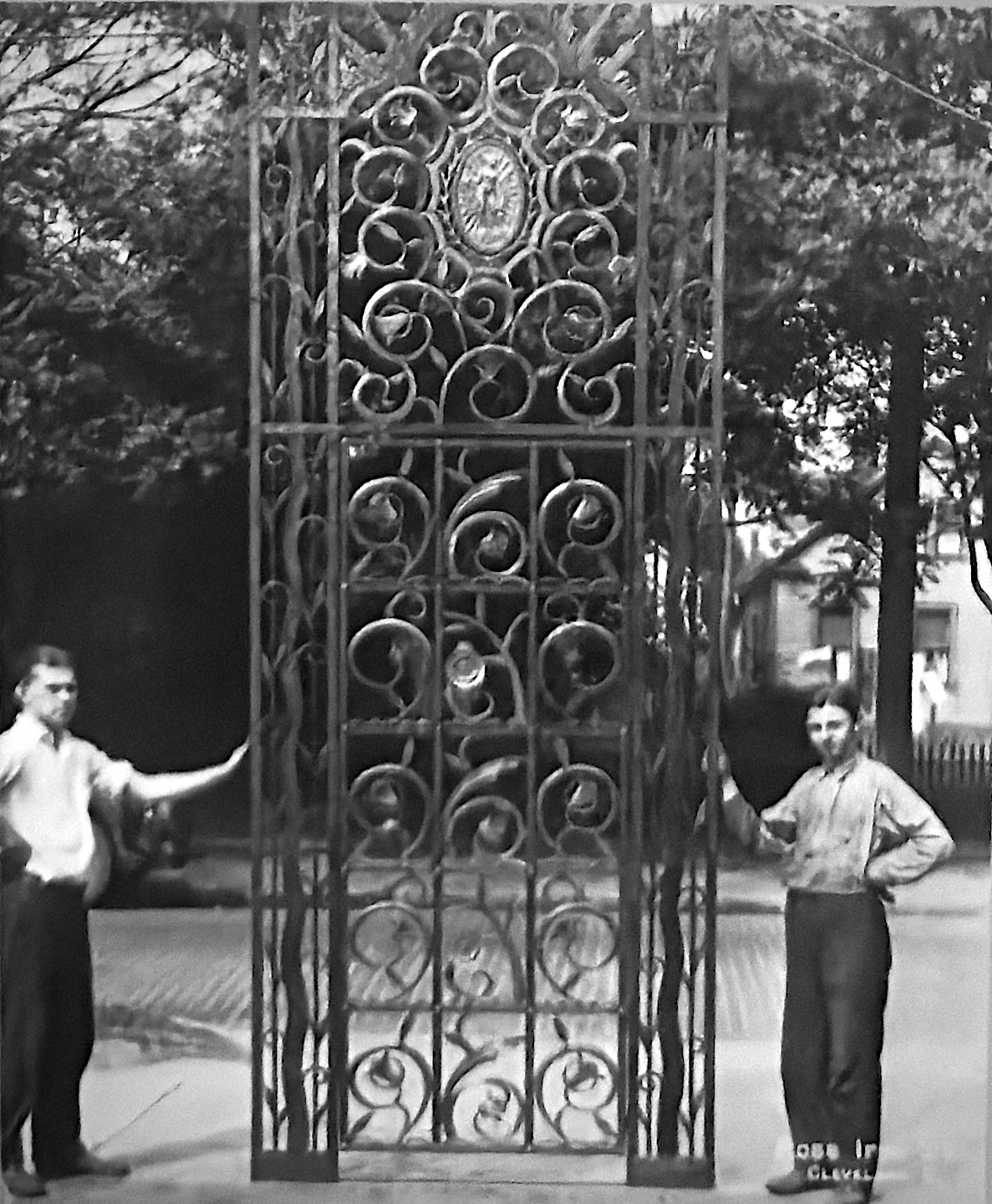
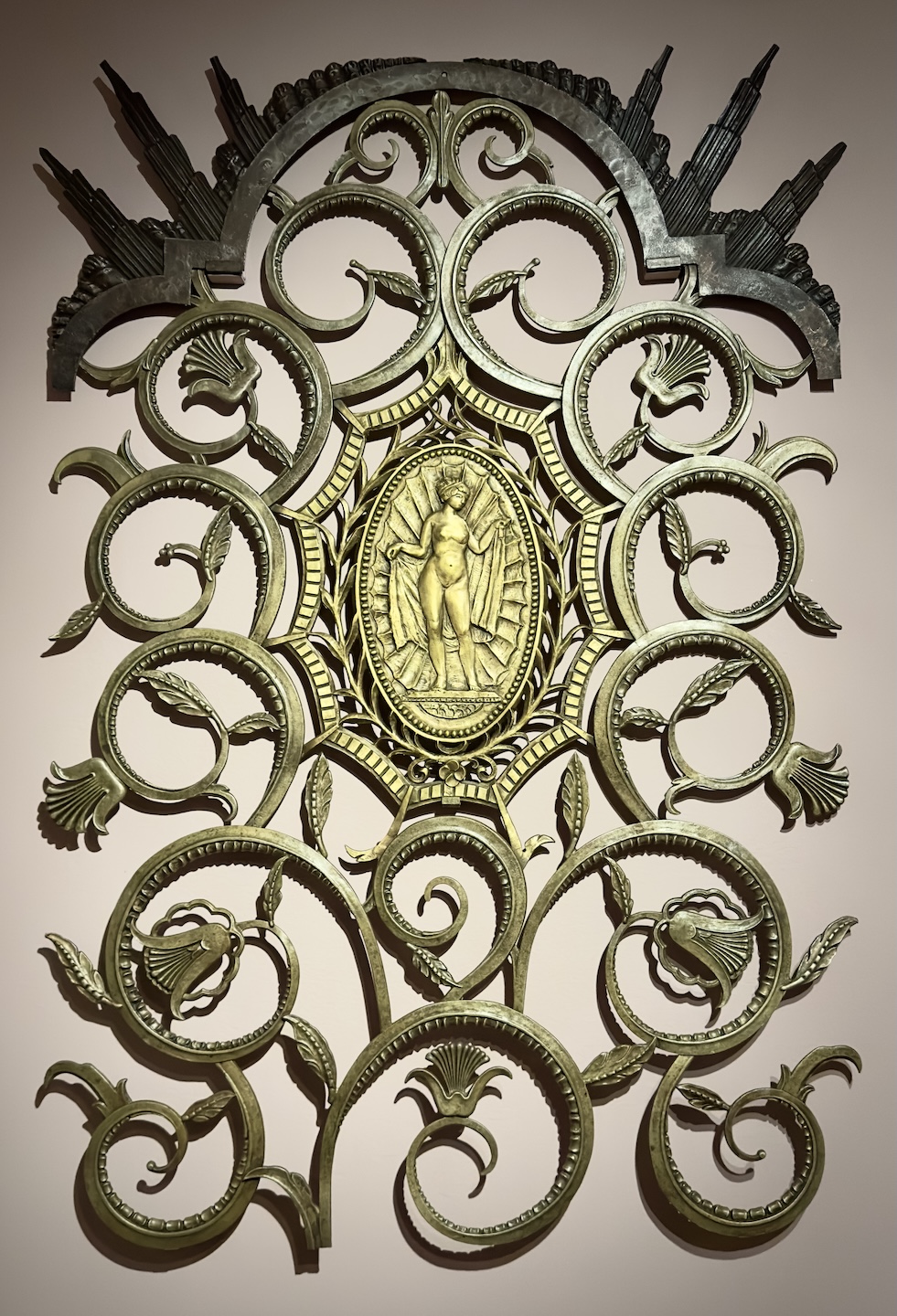
Grille for Halle Brothers Co. (1927)

Commissioned by the Halle Brothers Co. in 1927 this grille was for a dress room. It is now  in two pieces and missing its side panels.

Halle Brothers Co. dress room grille (bottom half)

Bottom, center section of the Halle Brothers dress room grille.

Top center section of dress room grille for Halle Brothers.

Top center section of the Halle Brothers Co. grille

Vintage photograph showing the Halle Brothers Co. grille showing it in its complete state.

Vintage photograph showing the Halle Brothers Co. grille showing it in its complete state.

Designs by Paul Fehér

The designs of Paul Fehér for Rose Iron Works are some of the best examples of Art Deco metal work made in the United States. While he is best known for the Muse with Violin screen, his work encompassed many objects.

Designs for Door Handles and Lamps

Design for door handles and lamps, 1931.

Design for door handles and lamps, 1930.

Fehér door handle and light switch cover, by Paul Fehér, circa 1930.

Door handle of monel (nickel alloy), aluminum and light switch cover of steel, aluminum, circa 1930.

Floor Lamp

As sales declined due to the Great Depression, Fehér created a number of moderne pieces to display in the Rose Iron Works showroom, to attract potential customers. This lamp was one of the pieces.

Rose Iron Works collection floor lamp.

Floor lamp for display in the Rose Iron Works showroom. The glass tubes of the shades are modern replacements.

Detail of the shade showing the replacement glass tubes.

1931 photograph of the Rose Iron Works showroom, featuring the floor lamp and mirror and console table.

Fountain

Circa 1930, Fehér made a drawing of a fountain. The copper and aluminum fountain would not be executed until 1950.

Drawing for a fountain.

A Paul Fehér drawing for a fountain, circa 1930.

The 1950 fountain based on the 1930 design.

Copper and aluminum Rose Iron Works fountain, 1950.

The Muse Screens

But the real highlights of the exhibit were the two muse screens, Muse with Violin (1930) and Muse with Flower (2025).

Muse with Violin Screen

Chalk and crayon drawing of a Muse Screen.

Drawing in chalk and crayon of Muse Screen, with an unexecuted central figure.

The drawing used in the Rose Iron Works workshop for Muse with Violin screen.

Workshop drawing for Muse with Violin Screen, 1930.

Muse with Violin Screen.

A Paul Fehér masterwork, Muse with Violin, 1930, for the Rose Iron Works.

Muse with Flower

In 2022, third-generation Rose Iron Works owner, Bob Rose embarked on a project to create two new Muse screens. One of the new screens featured the unexecuted Paul Fehér figure from 1930. Muse with Flower Screen’s central figure was inspired by a picture of Rose’s wife smelling a flower. Using a combination of old techniques, such as original tools and molds and 3-D printing, the new screens continue Rose Iron Works Art Deco craftsmanship that began nearly 100 years ago.

The 2025 Muse with Flower Screen’s central figure for Rose Iron Works.

Muse with Flower Screen (2025). Designed by Bob Rose for Rose Iron Works.

Even though it was a small exhibition, it was well worth the drive from Rochester and back.

Anthony & Chris (The Freakin’ Tiquen Guys)


Compact, Oui-kend Finds

I’m back with compact, oui-kend finds! A mixture of, dare you guess, compacts and a couple of French collectibles found at my local flea market, The Golden Nugget in Lambertville, NJ.

Avon Fan

Avon Fan Compact

A pair of Avon Fan Compacts (photo from the author’s collection)

To start, I picked up a couple of attractive compact cases used by the California Perfume Company for their Avon line in 1930.

The fan design was one of three proposed by designer, Andrew Shields for the Fillkwik Company of Attleboro, MA.

Fillkwik appears to be an offshoot of the Aetna Manufacturing Company.  The name is possibly taken from a 1917 cigarette case created and branded as “Fillkwik”.

Connected with both companies, Swedish immigrant Leonard Dahlgren either created or managed the Fillkwik Company. He applied for two patents in late 1920 and early 1921 for cigarette cases. And it appears this company only produced quality cases.

Around 1925, four investors looked for a manufacturer with the equipment to make small cosmetic containers . Fillkwik fit the bill and at age 50, Dahlgren may have been looking to sell.

Andrew Shields, the brains, along with Charles Agard probably provided the capital for the purchase. Charles Polsey had both the financial skills and experience manufacturing compact and vanity cases. And Felix Miller was a toolmaker experience in the manufacturing of high-end vanity cases.

A fifth man, Albert Mullen, may have been involved as well. Mullen was a co-founder of The American Perfumers’ Laboratories Inc, (aka APLI). APLI produced cosmetics such as powder, rouge and lipsticks and acted as a distributer for other cosmetic companies. It packaged their products in either in-house designed cases or though patent owed designs.

By 1927, APLI was looking for a reliable manufacturer of cosmetic case and Fillkwik fit the bill.

The typical large and heavy compacts of the early 1920s were out. Women wanted something slimmer, lighter and more colorful to reflect the new Art Deco style. Oblong shaped cases that contained face powder, rouge, and a metallic mirror were the go-to style.

In 1930 Fillkwik made a radical choice. It started with a decidedly deco design by Felix Miller. The case has descending steps on one side, Different from anything they ever produced before, Andrew Shields enthusiastically, embraced the new look. Three purely Art Deco shapes were designed and produced.

1931 Compact Advertisement

1931 Compact Advertisement (photo from collectingvintagecompacts.blogspot.com)

APLI publicity material announced the designs as the Cathedral, Fan and Romanesque.

Of the three cases, the California Perfume Company selected the fan shape for their Avon line of compact powder and rouge.

Unfortunately, though very attractive, the petite size proved impractical for the average 1930s woman.  Ladies were using face powder regularly throughout the day and evenings to “touch-up” their faces. The small size of the (Avon) Fan and the Cathedral compacts simply didn’t hold enough powder for repeated application without refilling or switching out the compacts.   Produced only in 1931, examples of the Fan compact are rarely seen today.

Avon Fan Compact

Note the polished metal mirror (photo from the author’s collection)

Avon Fan Compact

Variations of the interior (photo from the author’s collection)

And I picked up two! The interior of each compact varies from the other.

Marcel Franck Perfume Atomizer

I picked up the next item solely on its Art deco aesthetic.  It is heavy and while it does work, it could use a good shot of WD40!

Marcel Franck Perfume Atomizer

Marcel Franck Perfume Atomizer

The “Escale” mount (bulb) dates this piece to production between circa 1935 and 1972. This is an elegant and understated piece of Art Deco. The base is rectangular crystal and decorated with grooves in the thick ‘Baccarat’ style.

The Art Deco “bulb” is round and made of chromed metal. You dispense the perfume by depressing the disc decorated with concentric circles.

Marcel Franck Perfume Atomizer

Another view of the atomizer (photo from the author’s collection)

The Marcel Franck manufacturer is based in France and has been producing luxury perfume atomizers since 1882. Leopold Franck founded the company after seeing the popularity of perfumes and the early atomizers.

His son Marcel took over the business in 1907 upon Leopold’s death. Marcel was able to engage major crystal companies like Baccarat and Saint Louis, and the best glass artists (Lalique, Galle, Argy-Rousseau, etc.) for the bottles. All the containers are made in crystal or mouth blown Murano glass. By using precious materials such as crystal, brass, gold, palladium, etc., he turned atomizers into works of art. The Marcel Franck company quickly received worldwide recognition denoting quality and luxury.

The company, sold shortly before Marcels’ death, disappeared in the late 1990s.

Bernard Dennery, grand-son of Marcel Franck, decided to revive the brand in 2013. He launched two collections: Home and Purse atomizers.


Souvenir Photo Book

Paris souvenir photos

Paris souvenir photos

A souvenir photograph set of famous sights of France was my last purchase. These were, and still remain, a popular keepsake. Generally inexpensive, soldiers would pick these up to send home to show the folks back home where they’d been and what they’d seen.

Paris souvenir photos

Assortment of Parisian sights

This collection of 20 photos is complete plus 1.  The plus 1 is a picture of a soldier.  I like to think this young man included his picture to show his family he was alive and well.

Photo of the soldier found in the packet of Paris souvenir pictures.

The photograph of the soldier found with the Paris souvenir pictures.


You never know what you’ll find when hitting a flea market. Happy Hunting!                Chris & Anthony (the Freakin’ ‘tequen Guys)

Sources:

collectingvintagecompacts.blogspot.com/2011/03/fillkwik-attleboro-avon-and-apli.html

marcelfranck.myshopify.com/pages/about-us